Introduction
Most people understand that exercise is good for them, yet many struggle to integrate it into their lives—particularly when weight loss is the primary goal. The common narrative suggests that if you exercise hard enough, the pounds will fall off. This oversimplification has led to frustration for millions who exercise consistently but see minimal weight loss.
The reality is more nuanced. Physical activity plays a critical role in weight management and overall health, but not always in the way popular culture suggests. This article examines what research actually tells us about exercise and wellness, offering practical guidance for incorporating physical activity into daily life in ways that stick.
What Physical Activity Is (and What It Isn’t)
The terms “physical activity” and “exercise” are often used interchangeably, but they have distinct meanings. According to the National Institutes of Health, physical activity encompasses all movement that creates energy expenditure, while exercise refers to planned, structured physical activity with a specific fitness goal.
This distinction matters because it shapes expectations. Physical activity is not exclusively a weight-loss tool. It is a fundamental pillar of health that delivers benefits regardless of whether the scale moves. The common misconception that one can “out-exercise” a poor diet is particularly damaging. According to the CDC, most weight loss occurs from decreasing caloric intake, not from increasing exercise alone. However, this does not diminish exercise’s critical role in maintaining weight loss once it is achieved.
Why Physical Activity Matters: Beyond the Scale
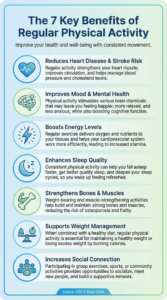
The benefits of regular physical activity extend far beyond calorie burning. The Mayo Clinic identifies seven key benefits of exercise: weight control, disease prevention, mood improvement, increased energy, better sleep, enhanced sexual function, and social connection.
The CDC provides an even broader list, noting that regular physical activity reduces the risk of heart disease, stroke, type 2 diabetes, several forms of cancer, arthritis, and osteoporosis. It also improves sleep quality, reduces high blood pressure, and decreases symptoms of depression and anxiety.
These benefits are not contingent on weight loss. A person who exercises regularly and maintains their current weight still experiences these health improvements. This is a crucial realization for anyone who has felt discouraged by a stalled scale despite consistent exercise.
Understanding the Different Types of Exercise
An effective physical activity routine includes multiple types of exercise, each contributing distinct benefits.
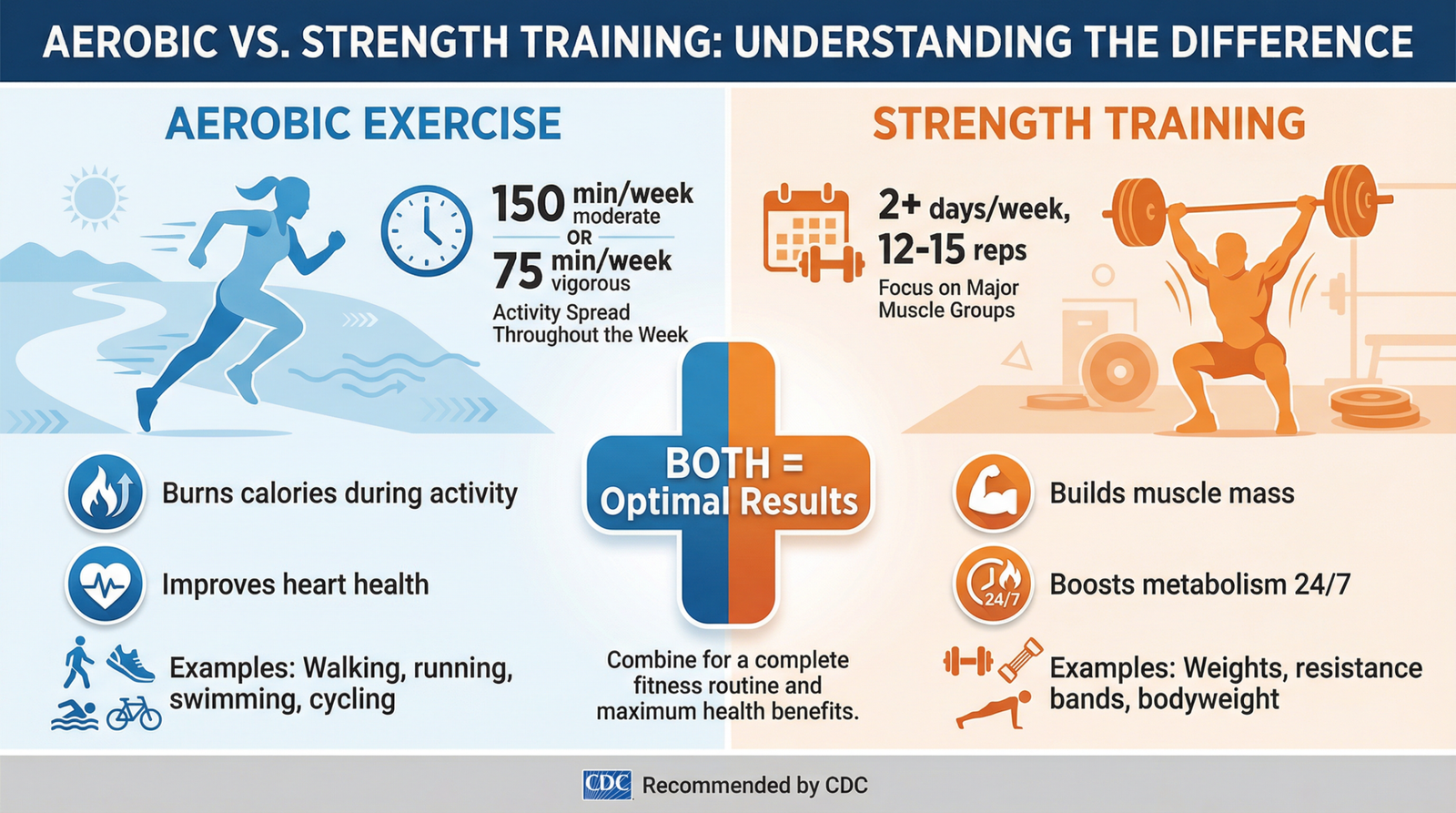
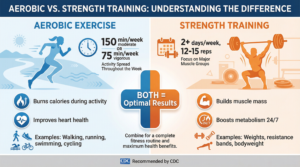
Aerobic Activity elevates heart rate and breathing. According to the CDC, moderate-intensity activities include brisk walking, light yard work, casual biking, and actively playing with children. Vigorous-intensity activities include jogging, swimming laps, competitive sports, and jumping rope. A 154-pound person burns approximately 140-185 calories during 30 minutes of moderate activity like brisk walking, compared to 220-295 calories during vigorous activity like running.
Strength Training builds and preserves lean muscle mass. According to the Mayo Clinic, strength training can be performed using body weight, resistance tubing, free weights, or weight machines. The benefits include improved metabolism, stronger bones, better balance, and enhanced ability to perform daily activities. Building muscle increases resting metabolic rate, meaning the body burns more calories even at rest.
The Research on Exercise and Weight Loss
The relationship between exercise and weight loss is more complex than commonly understood. A 2017 review published in Diabetes Spectrum examined multiple studies on this topic and found that exercise alone plays a relatively small role in weight loss. Subjects using exercise alone for weight reduction experienced minimal weight loss.
However, when exercise is combined with dietary restriction, results improve substantially. Additionally, when individuals successfully lose weight through any intervention, regular physical activity becomes essential for maintaining that loss.
The CDC recommends that adults engage in at least 150 minutes of moderate-intensity aerobic activity per week, or 75 minutes of vigorous-intensity activity, plus muscle-strengthening activities at least two days per week. Research suggests that significantly more activity—potentially up to 60 minutes daily—may be required to achieve clinically meaningful weight loss through exercise alone.
Practical Implementation: Building a Sustainable Routine
Start with a baseline assessment. Before beginning any new exercise program, especially for those over 40 or with chronic health conditions, consulting a healthcare professional is advisable.
Establish realistic goals. Begin with the CDC’s baseline recommendation of 150 minutes of moderate aerobic activity weekly, combined with two days of strength training.
Choose activities you enjoy. Consistency is the most important factor in long-term success. If someone dislikes running, forcing themselves to run will not lead to sustained exercise. Walking, dancing, swimming, cycling, or team sports are all valid options.
Integrate strength training. According to the Mayo Clinic, a single set of 12-15 repetitions with proper weight can build muscle efficiently. Two sessions per week targeting all major muscle groups is sufficient.
Build activity into daily life. Taking stairs instead of elevators, parking farther away, or doing household chores more vigorously all contribute to daily activity levels and require no special equipment.
Monitor progress beyond the scale. Track improvements in strength, endurance, mood, sleep quality, and energy levels. These non-scale victories often appear before significant weight changes and provide motivation to continue.
Common Pitfalls and Solutions
Pitfall: Expecting rapid weight loss from exercise alone. Many people become discouraged when exercise does not produce dramatic weight loss. The solution is to adjust expectations and recognize that exercise is most effective for weight loss when combined with dietary changes.
Pitfall: Doing only one type of exercise. Some people focus exclusively on cardio or only on strength training. The solution is to incorporate both for comprehensive benefits.
Pitfall: The “all or nothing” mentality. If someone misses a workout, they may abandon their routine entirely. The solution is to recognize that any activity is better than none.
Comparing Exercise Options
|
Exercise Type
|
Primary Purpose
|
Key Benefit
|
Examples
|
|
Aerobic
|
Cardiovascular health, calorie burning
|
Immediate calorie expenditure
|
Walking, running, swimming, cycling
|
|
Strength Training
|
Muscle building, metabolism boost
|
Increased resting metabolic rate
|
Weights, resistance bands, bodyweight
|
|
Flexibility
|
Injury prevention, range of motion
|
Reduced injury risk
|
Stretching, yoga
|
Practical Checklist for Getting Started
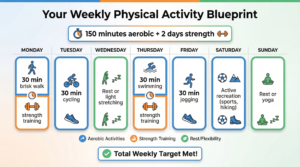
•Schedule three to four sessions of 30 minutes of moderate aerobic activity this week.
•Identify one strength training activity and perform it twice this week for 20-30 minutes.
•Choose one activity you genuinely enjoy.
•Track your activity and how you feel afterward.
•Set a specific, measurable goal (e.g., “walk 30 minutes, three times per week”).
•Identify a friend or family member to exercise with for accountability.
Frequently Asked Questions
How much exercise do I need to lose weight? While the CDC recommends 150 minutes weekly for health, research suggests more activity may be needed for significant weight loss through exercise alone. The most effective approach combines exercise with dietary changes.
Is cardio or strength training better for weight loss? Both are important. Cardio burns more calories during the workout, while strength training builds muscle that increases metabolism 24/7.
Can I just exercise and not change my diet? You can improve your health significantly, but substantial weight loss is unlikely without dietary changes. Diet is the primary driver of weight loss.
How long before I see results? Energy and mood improvements may appear within days. Strength gains typically become noticeable within 2-4 weeks.
What if I have no time for the gym? Many effective exercises require no equipment. Bodyweight strength training and brisk walking are excellent, accessible options.
Conclusion
Physical activity is not a magic solution for weight loss, nor should it be viewed as one. However, it is an essential component of overall health and wellness that delivers benefits far beyond the scale. Regular exercise improves cardiovascular health, mental well-being, bone density, and functional capacity.
For weight loss, exercise works best when combined with dietary changes. For weight maintenance, regular physical activity is critical. The most sustainable approach integrates both aerobic and strength training into a routine built around activities the individual actually enjoys.
Start with the CDC’s baseline recommendation of 150 minutes of moderate aerobic activity plus two days of strength training weekly. Choose activities you genuinely enjoy. Track progress through multiple lenses—strength, energy, mood, and sleep—not just weight. Most importantly, focus on consistency over intensity. The best exercise program is the one you will actually do.
References