Embarking on a weight loss journey is a significant commitment, and the way you set your goals can be the single most important factor in determining your long-term success. While the desire for rapid transformation is common, the evidence overwhelmingly points to the power of realistic, well-defined objectives. Setting the right goals from the start builds momentum, sustains motivation, and prevents the frustration that leads many to abandon their efforts.
This article provides a thorough, evidence-based guide for individuals beginning their weight loss journey. We will explore what constitutes a “realistic” goal, why it matters for your motivation and progress, and how to establish achievable targets based on your unique circumstances. You will learn a practical, step-by-step framework for setting goals that work.
What a Realistic Weight Loss Goal Is (and What It Isn’t)
A realistic weight loss goal is one that is achievable, sustainable, and tailored to your individual body and lifestyle. It is not a drastic, short-term target driven by unrealistic expectations. According to the Centers for Disease Control and Prevention (CDC), a gradual and steady pace of losing 1 to 2 pounds per week is more sustainable and effective for long-term success .
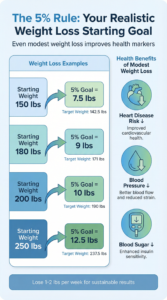
Clinically, a realistic initial goal is often defined as a modest percentage of your current body weight. The Mayo Clinic suggests that a goal of losing 5% of your current weight is an excellent starting point . For a person weighing 200 pounds, this translates to a 10-pound loss. This initial success can significantly improve health markers and build the confidence needed for continued progress.
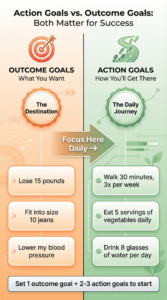
A realistic goal is also process-oriented, not just outcome-focused. It’s the difference between saying “I want to lose 20 pounds” (the outcome) and “I will walk for 30 minutes, three times a week” (the process). The latter is an action goal—a specific, controllable behavior that leads to the desired outcome .
Why It Matters / When It’s Useful
Setting realistic goals is crucial because it directly impacts your psychological state and motivation. Unrealistic goals, such as losing 20 pounds in two weeks, can lead to feelings of defeat and frustration when they are not met, making it more likely that you will give up .
Conversely, achieving small, realistic goals creates a positive feedback loop. Each success builds self-efficacy—your belief in your ability to succeed—which in turn fuels your motivation to continue. According to the CDC, rewarding these achievements with non-food rewards, like a relaxing bath or a new book, further reinforces this positive cycle .
This approach is particularly useful at the beginning of a weight loss journey, when building momentum is most critical. It is also essential for anyone who has previously struggled with weight loss, as it provides a structured, less intimidating path forward.
Key Concepts Readers Must Understand
To set effective weight loss goals, it is important to understand the following key concepts:
•Outcome Goals vs. Action Goals: As defined by the Mayo Clinic, an outcome goal is the result you want to achieve (e.g., “lose 15 pounds”). An action goal is the specific behavior you will perform to get there (e.g., “eat five servings of vegetables daily”) . A successful plan requires both, but your daily focus should be on your action goals.
•Intrinsic vs. Extrinsic Motivation: Your motivation is your “why.” A large-scale study published in the Journal of Medical Internet Research found that individuals motivated by intrinsic factors like health and fitness achieved greater weight loss and were less likely to drop out of a program than those motivated by extrinsic factors like appearance . Understanding your core motivation is a foundational step.
•The 5% Rule: A modest weight loss of just 5% of your body weight can lead to significant health benefits, including improved blood pressure, cholesterol, and blood sugar levels, and a lower risk for chronic diseases like heart disease and type 2 diabetes . This makes it a powerful and highly motivating initial target.
Step-by-Step: How to Approach and Evaluate Your Goals
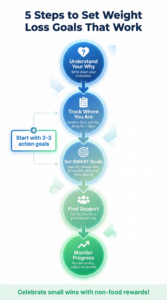
Follow this structured approach, based on guidance from the CDC, to set and evaluate your weight loss goals .
Step 1: Understand Your “Why”
Before setting any goals, clarify your motivation. Are you aiming to improve your health, have more energy for your family, or manage a medical condition? Write down your reasons and keep them visible as a daily reminder.
Step 2: Establish a Baseline
For a few days, track your current habits without judgment. Use a diary or an app to record:
•Nutrition: What and how much you eat and drink.
•Physical Activity: The type, duration, and frequency of your movement.
•Sleep: How many hours you sleep each night.
This provides a clear picture of where you are starting from.
Step 3: Set Your SMART Goals
Use the SMART framework to create effective goals:
•Specific: Clearly define what you want to accomplish. Instead of “eat better,” use “I will pack a healthy lunch for work four days a week.”
•Measurable: Quantify your goal. “Walk for 30 minutes” is measurable; “walk more” is not.
•Achievable: Your goal should be challenging but realistic. If you don’t exercise at all, a goal of walking 15 minutes, three times a week is a great start.
•Relevant: Ensure your goals align with your overall “why.”
•Time-Bound: Set a deadline. “I will lose 5% of my body weight in the next three months.”
Step 4: Focus on Action Goals
While you should have an outcome goal (e.g., lose 10 pounds), your primary focus should be on your action goals. The CDC recommends focusing on just two or three action goals at a time to avoid feeling overwhelmed .
Common Pitfalls and How to Avoid Them
•Setting Only Outcome Goals: Focusing solely on the number on the scale can be discouraging, as weight can fluctuate daily. Avoid this by concentrating on your daily action goals, which are within your control.
•Comparing Your Journey to Others: The CDC emphasizes that everyone is different. Factors like genetics, age, medical conditions, and lifestyle all play a role . Avoid this by focusing on your own progress and what works for your body.
•Viewing Setbacks as Failure: Occasional setbacks are an expected part of the process. Avoid this by reframing them as learning opportunities. Analyze what happened and plan how to handle similar situations in the future.
Options / Approaches (Compare Tradeoffs)
When it comes to the size of your goal, research presents some interesting tradeoffs.
|
Goal-Setting Approach
|
Description
|
Pros
|
Cons
|
|
Modest Goals (5-10%)
|
Setting a clinically recommended goal of 5-10% weight loss.
|
Widely supported by health organizations . Reduces disease risk. Feels achievable, which can boost initial motivation.
|
May feel less inspiring for some. Some research suggests it may not lead to the greatest overall weight loss compared to more ambitious goals .
|
|
Ambitious Goals (>10%)
|
Setting a goal to lose more than 10% of your body weight.
|
A 2023 study of over 36,000 people found that setting goals of >10% was associated with greater weight loss and a lower likelihood of dropping out .
|
May feel overwhelming for beginners. Carries a higher risk of disappointment if not achieved, though the aforementioned study challenges this assumption.
|
For a beginner, the most practical approach is to start with a modest, realistic goal (5% of body weight) and then set a more ambitious goal once initial success has been achieved.
Practical Checklist
Use this checklist to ensure your goals are set up for success:
FAQs
1. How quickly should I expect to lose weight?
A safe, sustainable, and realistic rate of weight loss is 1 to 2 pounds per week, according to the CDC .
2. What if I have a lot of weight to lose?
If you have a significant amount of weight to lose, it is even more important to break it down into smaller, intermediate goals. Start with a 5% weight loss goal. Achieving this will provide both health benefits and the motivation to continue.
3. Is it better to focus on diet or exercise goals first?
For sustainable weight loss, both are crucial. However, when starting out, it can be effective to focus on one or two small changes in each area. For example, you could set one goal related to nutrition (e.g., adding a vegetable to every dinner) and one related to activity (e.g., taking a 10-minute walk at lunchtime).
4. What if I don’t achieve my goal in the timeframe I set?
This is a common experience and should not be viewed as a failure. Re-evaluate the goal. Was it truly realistic? What barriers did you encounter? Adjust the goal or the timeframe and continue moving forward.
Conclusion
Setting realistic weight loss goals is not about limiting your potential; it is about building a strategic and sustainable path to success. By focusing on gradual progress, celebrating small victories, and prioritizing actionable behaviors, you transform an overwhelming challenge into a series of manageable steps.
•A realistic initial goal is to lose 5% of your current body weight at a pace of 1-2 pounds per week.
•Focus on action goals (controllable behaviors) rather than just outcome goals (the number on the scale).
•Motivation rooted in health and fitness is associated with greater success than motivation based on appearance.
•Use the SMART framework to create specific, measurable, achievable, relevant, and time-bound goals.
•Treat setbacks as learning opportunities, not failures.
Your first action is to take 15 minutes to complete Step 1 and Step 2 of the framework above. Clearly define your “why” and track your habits for a few days to establish a baseline. This foundational work is the first and most important step toward achieving your long-term health objectives.
References