
The quest for a longer, healthier life is as old as humanity itself. While ancient myths spoke of fountains of youth, modern science is uncovering the cellular mechanisms that govern aging. Emerging from this research is a compelling body of evidence suggesting that one of the most powerful interventions for promoting longevity isn’t a futuristic pill, but a return to an ancient practice: intermittent fasting (IF).
Far more than a simple weight-loss trend, intermittent fasting is a strategic approach to eating that has profound effects on our biology. By manipulating the timing of our meals, we can trigger powerful, built-in pathways for cellular repair, rejuvenation, and resilience. This article delves into the robust scientific link between intermittent fasting and longevity, exploring how it works at a cellular level and offering evidence-based guidance for integrating this practice into a long-term health strategy.
What is Intermittent Fasting?
Intermittent fasting is not a diet in the conventional sense; it doesn’t dictate what you eat, but rather when you eat. It involves cycling between periods of voluntary fasting and non-fasting. The most common protocols include:
•Time-Restricted Feeding (TRF): This involves consuming all daily calories within a specific window, typically 6-10 hours, and fasting for the remaining 14-18 hours. The 16/8 method is a well-known example.
•The 5:2 Diet: This approach involves eating normally for five days of the week and restricting calorie intake to approximately 500-600 calories on two non-consecutive days.
•Alternate-Day Fasting (ADF): This protocol involves alternating between days of normal eating and days of complete or significant calorie restriction.
These structured eating patterns initiate a metabolic switch, shifting the body from using glucose as its primary fuel to burning stored fat, a process that unlocks a cascade of health-promoting cellular responses.
The Cellular Secrets to Longevity: How Fasting Rewires Our Biology
The magic of intermittent fasting lies in its ability to activate ancient, conserved genetic programs for survival and repair. When the body is deprived of external nutrients, it turns inward, initiating a series of processes that are fundamental to slowing the aging process.
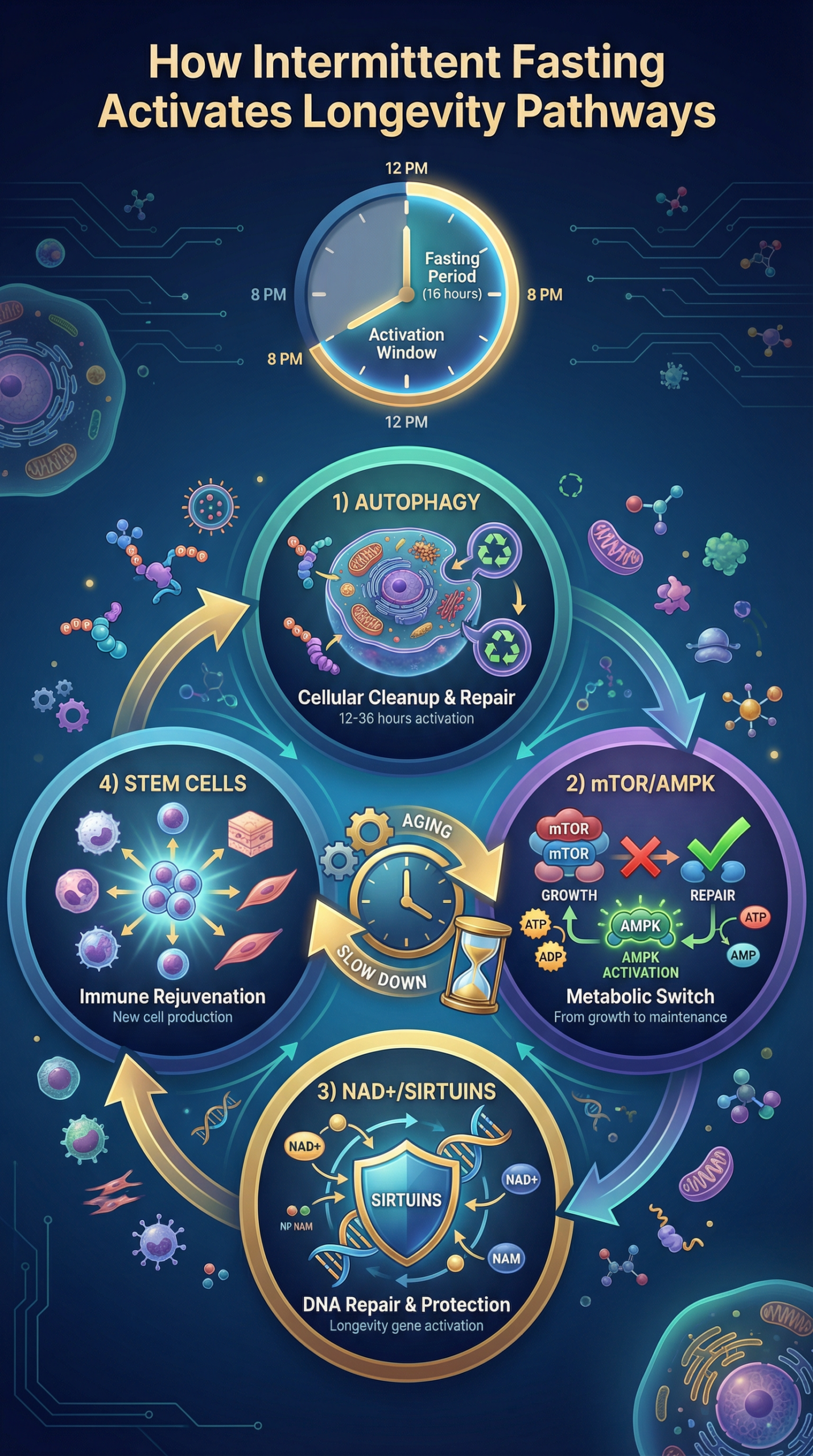
Autophagy: The Body’s Cellular Cleanup Crew
At the heart of fasting’s anti-aging effects is a process called autophagy, a term derived from the Greek for “self-eating.” This cellular housekeeping mechanism, for which Yoshinori Ohsumi was awarded the 2016 Nobel Prize in Physiology or Medicine, is the body’s way of cleaning out damaged cells, misfolded proteins, and dysfunctional mitochondria .
During a fast, as nutrient levels fall, autophagy ramps up significantly. Cells begin to systematically break down and recycle their old, worn-out components. This process is critical for several reasons:
•It prevents the accumulation of toxic cellular waste, which is a hallmark of aging and neurodegenerative diseases.
•It provides raw materials for cellular repair and regeneration.
•It improves mitochondrial efficiency, enhancing energy production and reducing oxidative stress.
Autophagic activity declines with age, contributing to the aging process itself. Intermittent fasting is one of a few powerful, non-pharmacological ways to robustly stimulate this essential cleansing process, effectively helping cells stay younger and more functional for longer.
The mTOR and AMPK Pathways: A Metabolic Crossroads
Two key signaling pathways, mTOR and AMPK, act as a master switch between growth and repair.
•mTOR (mammalian Target of Rapamycin) is a central regulator of cell growth and proliferation. It is activated by the presence of nutrients, particularly proteins and carbohydrates. While essential for development, chronic mTOR activation is linked to accelerated aging and age-related diseases.
•AMPK (AMP-activated protein kinase) is an energy sensor that is activated when cellular energy is low, such as during fasting or exercise.
Intermittent fasting creates the ideal conditions to tip this balance in favor of longevity. By reducing nutrient intake, fasting suppresses the mTOR pathway, putting the brakes on cellular growth and division. Simultaneously, it activates AMPK, which in turn triggers autophagy and promotes the use of stored fat for energy . This metabolic shift from a state of “growth and storage” to one of “conservation and repair” is a fundamental mechanism by which fasting extends healthspan.
The NAD+ and Sirtuin Connection: Guardians of the Genome
Sirtuins are a family of seven proteins (SIRT1-7) often referred to as “longevity genes.” They play a crucial role in maintaining cellular health by regulating DNA repair, inflammation, and metabolic function. However, sirtuins require a critical coenzyme to function: NAD+ (nicotinamide adenine dinucleotide).
Unfortunately, NAD+ levels decline significantly as we age, impairing sirtuin activity and contributing to the aging process. Intermittent fasting has been shown to be a potent strategy for boosting NAD+ levels . This increase in NAD+ fuels sirtuin activity, leading to:
•Enhanced DNA repair and genomic stability.
•Improved mitochondrial function and biogenesis.
•Reduced inflammation and enhanced cellular stress resistance.
By restoring the NAD+/sirtuin axis, fasting helps protect the very blueprint of our cells from age-related decline.
Stem Cell Rejuvenation and Immune Resilience
Perhaps one of the most exciting areas of research is the effect of fasting-refeeding cycles on stem cells. Studies, particularly those on periodic fasting (fasts lasting 2-5 days), have shown that these cycles can trigger a regenerative process. During the fast, the body clears out old and damaged immune cells. Then, upon refeeding, stem cells are activated to produce new, healthy immune cells, effectively rejuvenating the immune system .
This process helps to reverse the age-related skewing of the immune system, improving its ability to fight off infections and conduct surveillance against cancerous cells. This highlights a key distinction: the regenerative power of fasting is unlocked not just by the fast itself, but by the subsequent, nutrient-rich refeeding period that provides the building blocks for new growth.
The Evidence: From Lab to Lifestyle
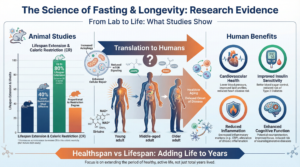
Decades of research in model organisms—from yeast and worms to mice—have consistently shown that dietary restriction, including intermittent fasting, can extend lifespan, in some cases by as much as 80% . A landmark 2024 study in Nature confirmed that both caloric restriction and intermittent fasting extended the lifespan of genetically diverse mice, with the effect being proportional to the degree of restriction .
While conducting multi-decade lifespan studies in humans is impractical, a wealth of clinical research has demonstrated that intermittent fasting significantly improves healthspan—the years of life lived in good health. Human trials consistently show that IF can:
•Improve insulin sensitivity and reduce the risk of type 2 diabetes.
•Lower blood pressure and improve cardiovascular health markers.
•Reduce systemic inflammation and oxidative stress.
•Promote weight loss, particularly of visceral fat.
These improvements in the hallmarks of aging provide strong indirect evidence for the pro-longevity effects of intermittent fasting in humans.
Practical Guide: Incorporating Intermittent Fasting for Longevity
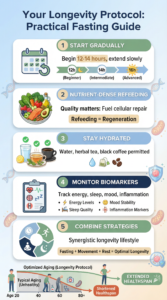
Adopting intermittent fasting should be a gradual and personalized process. The following tips can help you integrate it safely and effectively:
1.Start Slow: If you are new to fasting, begin with a shorter fasting window, such as 12-14 hours (e.g., finishing dinner by 7 p.m. and eating breakfast at 9 a.m.). Gradually extend the fast as your body adapts.
2.Prioritize Nutrient-Dense Refeeding: The refeeding window is not a license to eat junk food. Focus on a whole-foods diet rich in protein, healthy fats, fiber, and micronutrients to provide your body with the materials needed for cellular repair and regeneration.
3.Stay Hydrated: During your fasting period, drink plenty of water, herbal tea, or black coffee. This helps manage hunger and supports cellular function.
4.Listen to Your Body: Pay close attention to your energy levels, mood, and sleep quality. Fasting should make you feel better, not worse. If you experience persistent negative symptoms, consider shortening your fast or taking a break.
5.Combine with Other Longevity Pillars: Intermittent fasting is most powerful when combined with other healthy lifestyle habits, including regular exercise, adequate sleep, and stress management.
Conclusion: A Timeless Strategy for a Longer, Healthier Future
Intermittent fasting is far more than a passing fad; it is a powerful, evidence-based intervention that taps into the body’s innate capacity for repair and rejuvenation. By activating ancient pathways like autophagy, modulating key metabolic sensors like mTOR and AMPK, and boosting the activity of longevity genes like sirtuins, fasting offers a multi-pronged approach to slowing the aging process at a cellular level.
While the dream of immortality remains in the realm of fiction, science shows that we have considerable power to extend our healthspan. Intermittent fasting, when practiced thoughtfully and consistently, stands out as one of the most accessible and effective strategies for promoting cellular health, building resilience, and adding not just years to our life, but life to our years.
References